

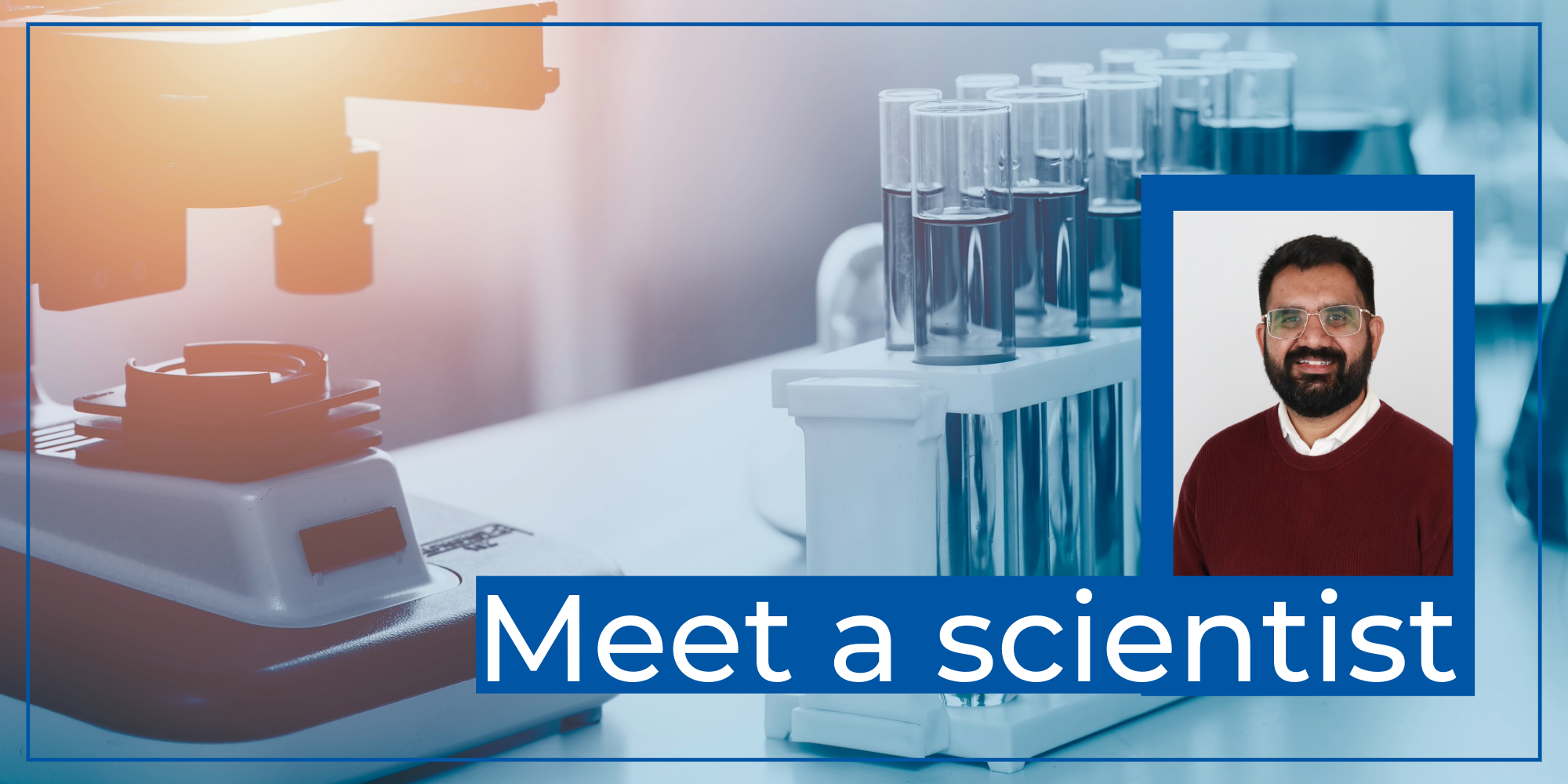
For Gurjinder Baath, Ph.D., farming and agriculture have been a constant in life. Growing up on a farm in Punjab, India, an agriculture-heavy region, he felt pulled toward an agricultural career.
“I was always attracted to farming. I used to go during my school holidays and spend most of the time at the farms,” Baath said. “When I finished high school, I chose agriculture. I said, ‘I want to be an ag specialist.’”
Now, as an assistant professor at Texas A&M AgriLife’s Blackland Research and Extension Center with a joint appointment in the Department of Soil and Crop Sciences at Texas A&M University, Baath combines agriculture and technology to improve farming techniques and crop yield.
From farm to classroom
Baath began his journey at Punjab Agricultural University, a top agricultural school in India.
“I learned there that an ag degree really is very comprehensive; there is so much going on. It’s not just cultivating or growing; there are so many different disciplines, different branches of agriculture,” he explains. “I met some great scientists there, and I began going with some of the scientists to help them collect data. So, I started liking research.”
After graduating, Baath knew he wanted to continue exploring agricultural research and applied to programs in the United States.
“The U.S. is a leader in terms of ag research. So, I started applying,” he said. “I wanted to be more in the southern U.S., because the weather is more like back in India. I got admitted to New Mexico State University, where I started my master’s.”
Pursuing graduate school in the U.S.
New Mexico is a state of deserts, plains and mountains. Baath’s new research focused on desalination of salty water and its application in chili pepper production within greenhouses.
After completing his master’s, Baath wanted to conduct active field crop research. He found that opportunity at Oklahoma State University (OSU), where he started his Ph.D. in crop science.
“It was a position funded by USDA-ARS in Oklahoma, and I got to work at different locations, on different crops,” he said. “It was basically an agronomy role where you grow and evaluate some crops, look at how well they’re growing, and how well they are setting seed.”
“So, I started like that, but I was more into technology, even though it was not a major part of my Ph.D research. As I was learning, I was working a lot on the crop physiology side, and got exposed to the crop modeling group there, and then the drones, or UAVs, and the remote sensing portion, towards the end of my PhD, which was not a major part of my Ph.D. I was just exploring those fields, and I got some good collaborations.”
Leading impactful research at Texas A&M AgriLife
Baath continued his work as a postdoctoral researcher at OSU until 2022, when an opportunity at the Texas A&M AgriLife’s Blackland Research and Extension Center in Temple allowed him to make the move to Texas A&M.
“Even though I’m a trained agronomist with a Ph.D. focused on agronomy, my position is in digital agriculture now, so I work on drones, and a lot more on crop modeling,” he said.
Two of Baath’s main research areas are crop modeling and remote sensing using drones.


Baath conducting fieldwork with drones.
Crop modeling normally involves two separate groups, he explains: the engineers or professionals building the computer model, and the agronomists collecting the field data.
Working with farmers or researchers in the field to collect data that is then plugged into models, Baath and his team can calibrate their model to see the potential effects of current farming practices years into the future.
“We work with many scientists across the state to use crop modeling and find solutions,” he said. “We try to extrapolate at a regional level and on a longer timescale, to understand what the best we can do is and how to optimize it.”
Remote sensing to collect crop data
Remote sensing in agriculture uses devices such as satellites and drones to collect imagery data of crops. Researchers then analyzed this data to understand how the crop is performing.
“Remote sensing-wise, we are doing a lot of drone and satellite work in order to understand plant parameters,” Baath said. “I work a lot on corn and cotton; if we fly the drone over a field, can we tell how the crop is performing? What is the plant height, what is the biomass, how much yield can we expect and a lot more.”
Using his experience on both sides of the work, Baath has been able to create a unique role for himself.
“What I’m trying to do in both of these fields is bridge the gap, because while we are collecting remote sensing data, we need to think from the farmer’s point of view, from the application point of view, rather than just making scientific innovations, we need to look at the practical application in the field,” he said.

Baath presenting at a training.
Helping producers
Today, bringing research into on-the-ground implementation that helps producers is his ultimate motivation.
“So, I think that’s what got me into this, I want to bring these two fields, modeling and remote sensing, into my skill set so that I can be more practical for the farmers. How can we use drones? How can we bring it to farmers? What problems can we address using these remote sensing technologies? How can we be more data-driven while solving some of the issues? So basically, I call it data-driven agronomy, because all the things we are doing are at the same field plot level.”
He aims for his research to continue to help develop agronomic management (e.g., optimum planting dates, optimum planting densities) and data that help producers make more informed decisions. Baath’s ultimate hope through his work is to help farmers and make these tools easier to access and utilize.
“The goals of the future are to have these technologies, whether it’s from modeling or remote sensing, in the hands of farmers. So, they can use these technologies to make decisions,” he said. “It currently requires a lot of technical skills, so we want to simplify this so that any farmer can do it. That’s the goal of my program.”


