


Today, about one in five new homes built in Texas rely on an individual wastewater treatment system, known as a septic system or on-site sewage facility (OSSF). Many older homes in rural and suburban areas also depend on OSSFs to treat their wastewater.
Despite their necessity, OSSFs can be difficult to find reliable information about, which can leave inexperienced homeowners with unanswered questions. In this article, learn how OSSFs work, what goes into their maintenance, and what advice water professionals have.
Septic Systems are also called On-Site Sewage Facilities (OSSFs). In many situations, OSSF is the preferred term, as it emphasizes the on-site aspect and encompasses many different types of systems.
What is an on-site sewage facility, and why are OSSFs important?
On-site sewage facilities (OSSFs) are systems that treat wastewater, typically for a single home or business, and discharge the treated water on the same property as the home rather than sending it to a larger municipal system for treatment.
OSSFs allow rural households to safely release water from sinks, toilets, laundry, etc. This helps prevent environmental contamination from untreated wastewater, which contains harmful bacteria, such as E. coli.
“Maintaining a properly functioning OSSF just comes down to protecting the environment you’re living in,” said Jeremiah Poling, deputy general manager of Angelina & Neches River Authority (ANRA). “This isn’t a nebulous thing. If this is dumping out in your backyard, especially where your kids play, you have sprinklers back there. The kids might be playing in that.”
How does an on-site sewage facility work?
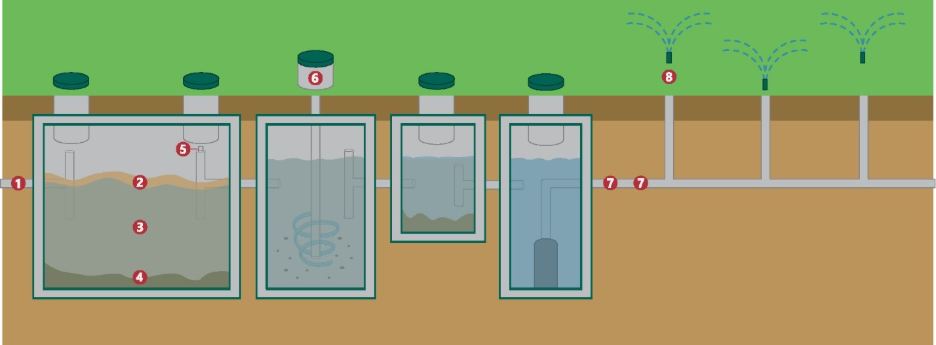
There are multiple types of on-site sewage facility (OSSFs), but the most common is the conventional septic system. In these systems, wastewater flows from the house through an inlet pipe (1) into a chamber where treatment begins. In this chamber, the heavy solids (4) separate and sink while the light solids (2) float on top of the liquid effluent (3).
The effluent then flows into a second chamber, where it is further treated and sometimes filtered by an effluent screen (6). You can access both chambers by using the access riser (5). The effluent then goes through an outlet pipe (7) to be dispersed through a drainfield (8). The plants and soil in the field take care of the rest, thanks to their natural ability to remove contaminants.

A common alternative type of OSSF is the aerobic treatment unit. These units have the added step of injecting oxygen into the treatment tank, which boosts treatment by aerobic bacteria. Then, the treated water is then land applied via sprinklers or other similar dispersal methods.
Aerobic treatment units are often suitable for smaller land, sandy or non-absorbing soils, areas with a high water table, and places close to sensitive water bodies.
If you’re interested in other types of OSSFs, the Environmental Protection Agency’s “Types of Septic Systems” Page provides information on a wide variety of tanks. To determine the best tank for your situation, consult with an OSSF professional.
How do you maintain an on-site sewage facility?
There are many tasks that must be done to properly maintain an on-site sewage facility (OSSF). Each task has a different timeline, purpose, and method. Here are the main maintenance tasks:
- Pumping: One of the most important parts of maintenance is pumping your OSSF. This involves an OSSF professional coming out with a large truck and using a pump to remove solid waste from the tank. Pumping should typically be done every 3-5 years, depending on water usage, number of people in the household, and type of system.
- Inspections: Conducting yearly inspections is recommended to check that everything is working properly. Simply walk around the drain field and the tank head. Check for any wet spots in the soil or bad odors. Also open the tank to check the water level and look for visible waste. If the tank is working properly, you won’t be able to see the water level.
- Screen cleaning: If your system has effluent screens, they need to be cleaned every 1-2 years. To clean them, put on gloves, hold the screen directly over the inlet compartment of the tank, and spray it with water until relatively clear water is coming off. This can be done by anyone, but hiring an OSSF professional is the safest option.
What NOT to do:
- Excessive laundry or dishes in one day – too much detergent in the system at one time
- Use harsh cleaning products – they kill the good bacteria in your system
- Flush “flushable wipes” – even if it says they’re flushable, they aren’t!
- Pour excessive fats, oils and grease down the drain
- Use septic system additives
- Chemical treatments: Depending on the design of your system, you may need to periodically add chemical treatments, such as chlorine or bleach. If your system doesn’t require this addition, don’t add it. Bleach and chlorine are powerful disinfectants, meaning they can kill the good bacteria in your system, leaving it unable to clean properly.
- Replacement: OSSFs do experience normal wear over time, especially if water usage is constantly high. They need to be fully replaced every 15-40 years, depending on the type of tank and amount of water usage. With proper care and consistent maintenance, concrete tanks can last up to 40 years, whereas plastic or fiberglass can last up to 20 to 30 years.
What happens when an on-site sewage facility fails?
On-site sewage facilities (OSSFs) can fail due to lack of maintenance or improper design. When lack of maintenance is the culprit, a buildup of solid waste clogs the system, preventing proper water discharge. In many cases, water backs up into the house, or a fracture occurs, leaking untreated water into the soil.
You’ll know your system isn’t working properly if you smell sewage, notice standing water, or abnormally green, happy plants. If you notice signs of failure, contact an OSSF professional.
“If you see water-loving plants grow somewhere where you don’t want water, then something’s leaking,” said Emily Monroe, Texas Water Resources Institute (TWRI) project specialist.
What advice do water professionals have?
“Educate yourself, stay on top of it and catch things when they’re small problems before they turn into bigger problems. If it does become a bigger problem, don’t be afraid to reach out and find help,” Poling said.
- Lawn care: Keep grass trimmed around your tank so it is easily identifiable. This is helpful for inspections and maintenance.
- Do the maintenance: It’s much easier and cheaper to maintain and repair than to have to replace the entire system.
- Be organized: Get a flipbook tracker to keep track of maintenance.
- Seek out resources: Look for grant programs and local nonprofits for repairs.
- Identify your designated representative: On-site sewage facilities are typically managed at the county level, so your representative will be a great resource. Call them if you have any issues or questions.
What on-site sewage facility work does TWRI do?
TWRI hosts free on-site sewage facility (OSSF) clinics as part of watershed protection plans, which are community-based plans to improve water quality. At these clinics, OSSF owners can learn about system maintenance, talk to wastewater specialists, and hear about water quality.
TWRI has also run multiple OSSF repair and replacement programs as part of watershed protection plans. The Attoyac Watershed Protection Plan (WPP) began in 2009 and was one of TWRI’s first WPPs. This WPP had great stakeholder involvement, Monroe said, making successful OSSF repair and replacement possible.
Poling worked on the first OSSF repair and replacement project in the Attoyac Watershed, which was led by ANRA. Soon after the project’s start, ANRA encountered an issue.
OSSF owners were hesitant to let ANRA see their systems. Because ANRA is the OSSF permitting authority for parts of the watershed, people feared being fined for having a failing or non-existent system. This complication led to TWRI joining the project, including Monroe.
Being able to work with TWRI, a third party that was not associated with enforcement, helped the watershed residents feel more comfortable asking for help, and failing systems were successfully identified and mitigated.
“We were partnering with TWRI to do the OSSF repair and replacement, and that was useful for two reasons. One, because it distanced the permitting/enforcement authority from the door-to-door trying to pitch the project to everybody,” Poling said. “Two, because the vendor contracting requirements for TWRI were a little bit less stringent than what they were requiring of ANRA, which allowed smaller and consequently less expensive vendors to bid on the OSSF work.”
In the end, the Attoyac WPP led to the replacement of around 60 OSSFs, making it a highly successful project that both protected local and regional water quality and improved the everyday lives of Texans.


